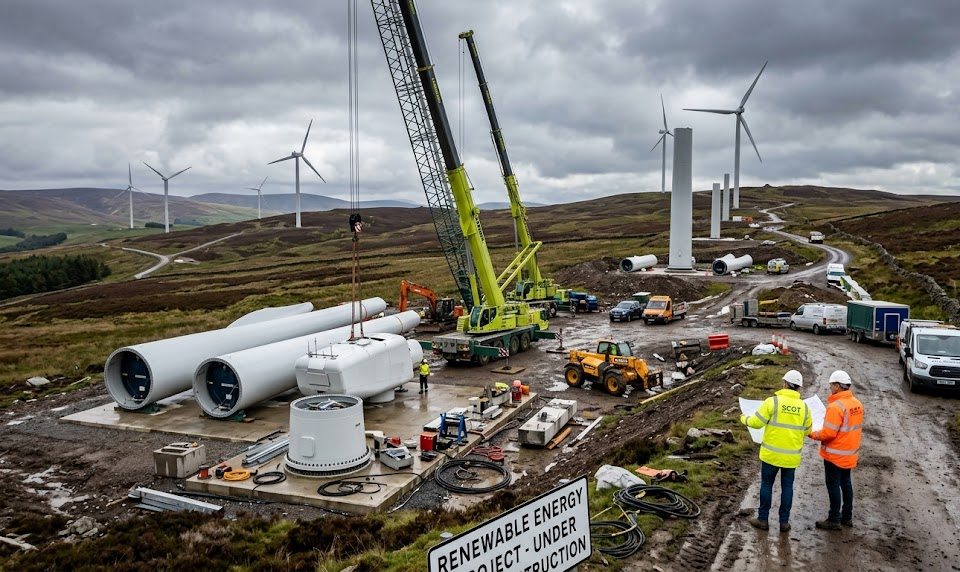
Record sums are flowing into UK renewable energy. The country has set bold targets to reach net-zero emissions. Thanks to strong political backing renewable energy projects are attracting major investment.
According to the UK Government, renewable energy accounted for 52.5 percent of total electricity generation in the UK, a majority share. Despite this milestone, many crucial projects are still facing persistent delays.
Something is not adding up.
Offshore wind farms are years behind schedule, solar projects are stuck, and grid upgrades are caught in planning delays. Projects with strong funding and public support keep hitting walls. The gap between ambition and delivery is wide, and it is getting wider.
At KG Internet, we share insight-led content with clear opinions and practical takeaways for business owners, marketers, and professionals.
Why Renewable Energy Projects Are Failing
Here is why renewable energy projects are failing:
1. Weak Planning Creates Costly Bottlenecks
Most project failures happen quietly, starting in the planning stage months or even years before work begins.
Planning large-scale energy projects is complicated. It requires the following:
- Site surveys
- Environmental assessments
- Stakeholder consultations
- Studies on grid connections
If any of these steps are rushed or skipped, it causes problems later.
For example: Hornsea 3 was ready to apply for consent in early 2020. However, environmental issues about seabirds along the Flamborough and Filey Coast delayed the submission until September 2021. Over a year passed before a single turbine was touched.
If the foundation is not strong, everything that follows will take longer and cost more.
2. The Overlooked Talent Gap
Renewable energy is a specialised field that needs skilled workers. This includes project managers, engineers, environmental consultants, and grid specialists who know how to manage offshore wind, solar, and large infrastructure projects.
The problem is that the industry is growing faster than the number of qualified workers. While universities and training programs are producing professionals, they aren’t doing so quickly enough to meet industry demand.
Hiring delays are often one of the biggest hidden risks in renewable energy projects. Teams that secure specialist talent early tend to move faster and avoid costly setbacks. According to industry experts, working with niche recruiters like LSP Renewables gives companies access to experienced professionals in offshore wind, solar, and also grid infrastructure, where general hiring channels struggle.
Hiring the wrong person for a senior position can delay a project by months, not just slow it down.
3. Supply Chains Struggling to Keep Pace
The global supply chain disruption of recent years left marks across every big industry. Sourcing materials like steel, specialised components, and cabling has become more challenging and costly.
Lead times for essential equipment have increased majorly across the industry. Turbine manufacturers are working at full capacity, and cable suppliers are facing backlogs.
Projects that were expected to deliver smoothly are now experiencing delays, with rising costs leaving teams idle.
For example: the industry is still reeling from the May 2025 cancellation of the 2.4 GW Hornsea Four project. Ørsted cited supply chain issues and execution risks as critical factors, leading to a capacity loss that still impacts UK energy projections.
The UK government has invested in boosting domestic manufacturing capacity, but it takes years to build supply resilience. Current projects are still feeling the impact of past decisions, or lack thereof.
4. Regulatory Barriers Stifling Ambition
Getting planning permission and connecting to the electricity grid can be very slow. In the UK, many projects are stuck in long queues for grid connections, with some waiting more than 10 years for approval.
A 2026 Mint Selection report found that 62% of projects might miss their connection dates, with the grid queue at 738 GW; over three times the UK’s capacity requirements by 2030.
Existing regulations cannot keep pace with the rapid pace of project development now. Changes are being made, but progress is slow.
Projects that do not include time for regulatory processes from the beginning often face unexpected delays. These delays are usually long.
5. Leadership Deficits in Complex Execution
Technical skills alone won’t make a project successful; good leadership is essential. It is difficult to find program directors, commercial leads, and senior project managers who have successfully worked on large renewable projects.
When leadership is weak or inexperienced, teams can fall apart. Decision time increases, hazards can be overlooked, and stakeholders may lose trust. A project that seemed doable on paper can start to fall apart.
Executing plans needs more than just technical skills. Leaders also need to understand regulations and have the business knowledge to handle risks worth billions of pounds.
For those looking to build capability at this level, explore this executive leadership programme, which helps c-suite executives build strong energy leadership skills.
Conclusion
The surge in investment across the UK renewable energy sector confirms its vital role in achieving net-zero, yet success is being undermined by a widespread execution gap. Project failures are rooted in systemic operational deficiencies, that includes insufficient planning, talent gap, fragile supply chains and crippling regulatory barriers.
To close this chasm between ambition and delivery, the industry must pivot its focus from securing funding to building deep internal capability. This means prioritising robust planning, rapidly securing specialist talent, and investing in the executive leadership needed to manage highly complex infrastructure.
Simply having dreams and goals isn’t enough; the UK’s net-zero future depends on rigorously translating investment into tangible, operational reality.